ECLIPSE DIGITAL at UPEC 2026: Exploring Graph Neural Networks for Power Grid State Estimation

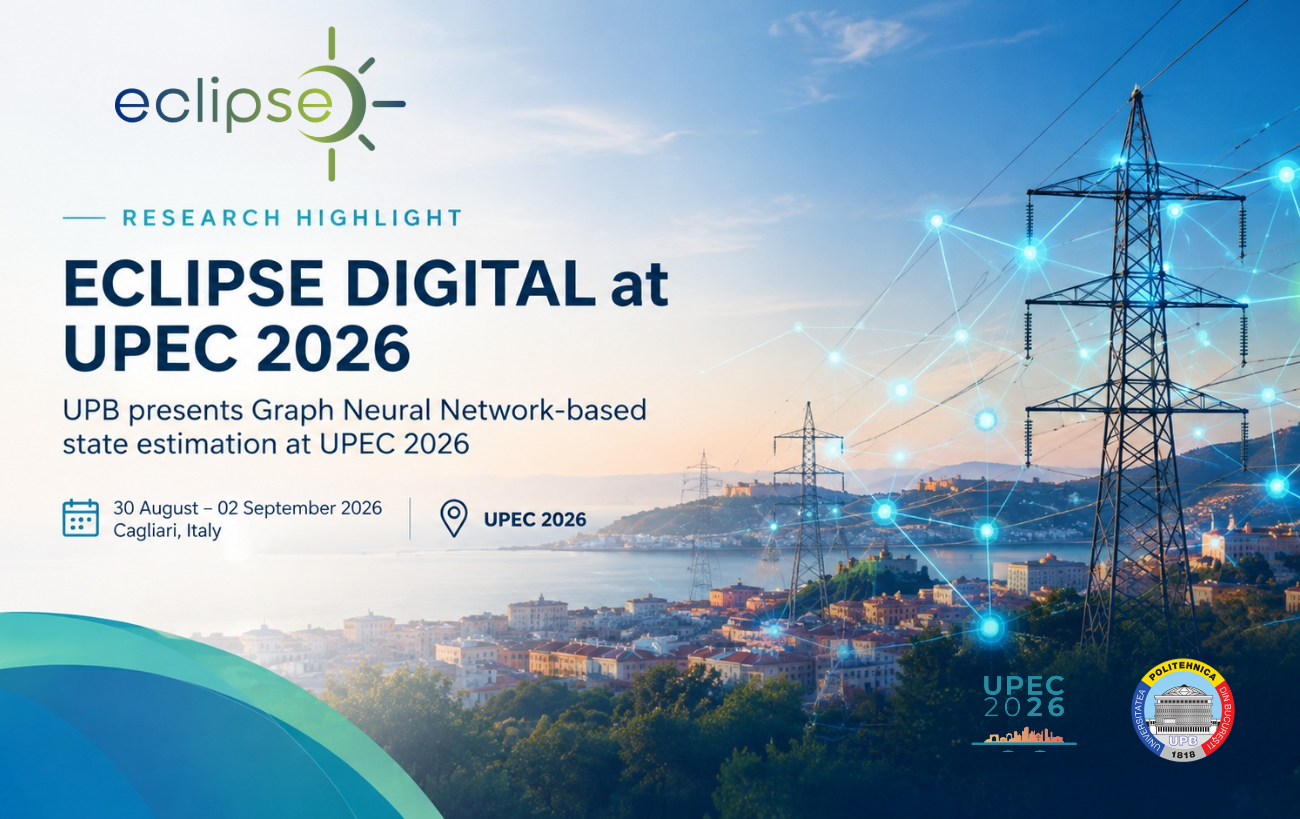
The 61st International Universities Power Engineering Conference (UPEC 2026) took place in Cagliari, Italy, from 30 August to 2 September 2026, bringing together researchers and professionals to discuss the future of power engineering. Representing ECLIPSE DIGITAL, project partner the University Politehnica of Bucharest (UPB) contributed to the conference with research on the use of artificial intelligence to improve power system analysis.
Graph Neural Networks for Distribution Grid State Estimation
UPB presented the paper “Graph Neural Network-Based State Estimation in Simulated Distribution Grids”, addressing a key challenge in smart grid management: estimating the state of distribution networks when measurements are missing or incomplete.
As electricity generation from renewable energy sources increases, accurate and reliable state estimation becomes increasingly important for operating distribution grids. The research explores how Graph Neural Networks (GNNs) can help address this challenge.
The proposed method uses OpenDSS to simulate power flows across generated network configurations, training a Graph Attention Network to estimate grid states through a masked reconstruction approach. The method was demonstrated on the IEEE-33 bus network. The study also examined training energy efficiency and the effect of different masking rates on estimation accuracy.
Connecting Research with ECLIPSE DIGITAL’s Objectives
Although focused on a specific technical challenge, this research reflects wider developments in the digitalisation of energy systems. Advanced data analysis and AI-based methods can contribute to more effective grid monitoring and management, particularly as networks accommodate increasing shares of renewable energy.
These developments complement ECLIPSE DIGITAL’s work on implementing and demonstrating the Common European Reference Framework (CERF), which supports interoperable energy applications and more accessible energy data. Together, such efforts contribute to the broader transition towards smarter, more flexible and sustainable energy systems.
Sharing Knowledge Across the Energy Community
Participation in UPEC 2026 provided an opportunity to share research findings and exchange knowledge with the international power engineering community, helping connect advances in AI and power system analysis with the wider challenges facing Europe’s energy sector.
The paper is available through here: