
An interactive workshop in Stockholm gave participants the opportunity to explore the latest developments in CheckWatt’s digital services, test the new mobile app and share feedback on its usability and features.
How can energy applications make it easier for consumers to monitor their energy systems and make the most of their flexibility resources?
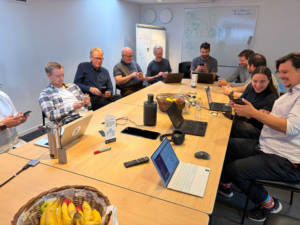
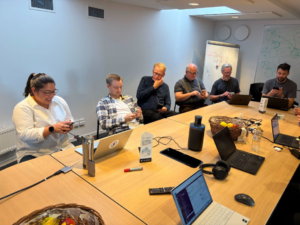
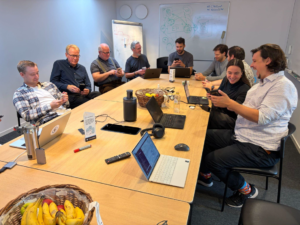
On 17 September 2026, CheckWatt organised the CheckWatt + ECLIPSE DIGITAL Workshop at its offices in Stockholm, Sweden. The session brought together 13 participants, both on-site and online, to learn about the ECLIPSE DIGITAL project, explore the developments carried out within the Swedish pilot and test the new CheckWatt mobile application.
The workshop was led by Peter Rosengren and Vivian Esquivias from CheckWatt and combined project presentations, live demonstrations, hands-on testing and an open discussion. Its main objective was to collect feedback from potential users to help further improve the application and the updated EnergyInBalance web portal.
From ECLIPSE DIGITAL to the Swedish pilot
The workshop opened with an introduction to ECLIPSE DIGITAL and its Common European Reference Framework (CERF), explaining the project’s objectives and its work towards more interoperable and consumer-oriented energy applications.
Peter Rosengren presented the European project and its demonstration activities, while Vivian Esquivias introduced CheckWatt’s contribution to the Swedish pilot.
CW-ECLIPSE.pdf (22 downloads )
Within ECLIPSE DIGITAL, CheckWatt has extended its existing EnergyInBalance web portal and developed a new mobile application using the same backend. These developments aim to bring different energy services together, helping users monitor their systems, understand their energy consumption and optimise the use of their assets.
The presentation also highlighted CheckWatt’s virtual power plant, Currently, which at the time of the workshop connected around 17,000 batteries with a total capacity of 350 MW, as well as the services available to asset owners and the flexibility markets supported by the platform.
Exploring new features through live demonstrations
Participants were introduced to the updated web portal and the new mobile app, with demonstrations of several functionalities developed within the Swedish pilot.
These included visualisations of solar production, electricity consumption, battery operation and appliance-level power information through Non-Intrusive Load Monitoring (NILM).
The presentation also covered the different ways CheckWatt’s services can benefit users, from behind-the-meter optimisation — including self-consumption, peak shaving and spot-price optimisation through CheckWatt AI — to participation in flexibility markets and services such as FCR-D, FCR-N, FFR, mFRR, aFRR and local flexibility for Distribution System Operators (DSOs).
Following the demonstrations, participants tested the app directly on their own smartphones. This hands-on approach allowed them to explore the interface, ask questions and share their impressions based on their actual experience.
User feedback: improvements and areas to refine
The interactive testing generated valuable feedback on both the app’s usability and its new functionalities.
Participants responded positively to the broader range of services offered by CheckWatt, particularly the addition of mFRR, local flexibility for DSOs and CheckWatt AI. The app’s performance and redesigned graphs were also well received, with one participant describing the new visualisations as a significant improvement over the previous version.
The possibility of accessing solar production, battery information and consumption data in a single application was another appreciated feature, making everyday monitoring more convenient.
The workshop also helped identify areas requiring further development. In particular, participants found the NILM functionality interesting but pointed out that some appliance-level readings were not yet sufficiently accurate. For example, the system occasionally indicated that devices such as televisions and kettles were operating during the night when they were not.
This feedback provides useful input for refining the technology and improving the reliability of the information presented to users.
Turning feedback into further improvements
The workshop was part of CheckWatt’s wider effort to collect user feedback on the updated EnergyInBalance portal and its new mobile application. The hands-on testing complemented an online survey previously conducted with EnergyInBalance users, providing additional insights through direct interaction and discussion.
The main takeaways confirmed the positive reception of the expanded service offering, the improved visualisations and the convenience of bringing energy information together in one app. At the same time, the feedback highlighted the importance of improving NILM accuracy before making the functionality more widely available.
By involving potential users in the testing process, the Swedish pilot is helping ensure that new digital energy services respond to real user needs, while contributing practical experience to ECLIPSE DIGITAL’s wider work on interoperable energy applications.