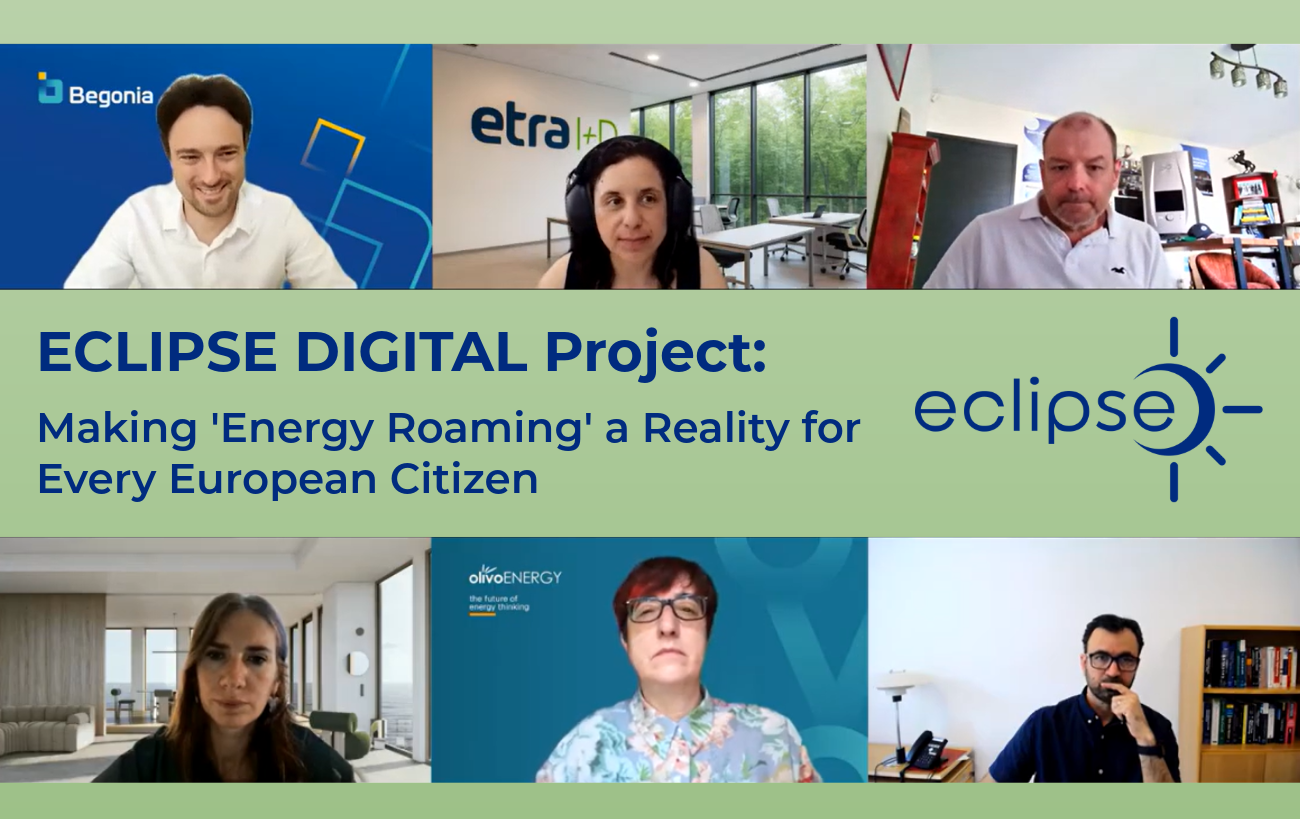

On a recent webinar hosted by the Begonia Project, energy experts and project leaders gathered for a dynamic roundtable discussion to explore the future of Europe’s digital energy ecosystem. Representing ECLIPSE DIGITAL, our project coordinator Lola Alacreu (ETRA I+D) joined representatives from the Begonia Project, SmartEn, and the INSIEME project to discuss how interoperable digital infrastructures can support the European energy transition.
ECLIPSE: A Foundation for Consumer Empowerment
During the session, Lola Alacreu highlighted the core mission of ECLIPSE Digital Project:
“Developing and demonstrating a Common European Reference Framework (CERF) for energy monitoring applications.”
While other projects focus on grid-level platforms or large-scale data centers, ECLIPSE DIGITAL Project is uniquely positioned at the heart of the domestic consumer experience. Key pillars of the project presented include:
- The CERF Blueprint: Defining protocols and rules to simplify the creation of energy applications that work across different operators and countries.
- Consumer Flexibility: Empowering households to not only monitor consumption but to actively participate in load shifting, reducing their bills while supporting grid stability.
- The “Roaming” Concept: Much like mobile phone roaming, ECLIPSE DIGITAL aims to make energy apps interoperable across borders, allowing users to maintain a seamless experience even if they change providers or move between EU countries.
Main Conclusions of the Roundtable
The discussion moved beyond technical results to address the strategic challenges of creating a unified European energy market. The panel reached several critical conclusions:
- Interoperability is the key to choice. Interoperability is not just a technical requirement; it is mandatory for customer choice. For the energy transition to succeed, consumers must be able to choose their own chargers, cars, and energy aggregators, with all devices speaking a common language.
- The Concept of the “Digital Spine”. The panel discussed the emerging concept of the “Digital Spine”, a digital foundation that brings data spaces, operational platforms, and consumer applications into harmony. For ECLIPSE DIGITAL, this spine represents the foundation that allows our monitoring apps to interact with flexibility markets and grid operators across Europe.
- Implementation via “Baby Steps”. A major takeaway was that while standards exist, they are often too complex or poorly implemented. Experts agreed that the industry needs to focus on minimum viable implementations, starting with simple data exchanges and building trust among stakeholders before scaling to more complex systems.
- Overcoming Regulatory Barriers. Despite European-level progress, national-level implementation of energy regulations remains a challenge. Participants emphasized that technology is ready; the focus must now shift to aligning national policies to ensure flexibility service providers can access the markets they need to thrive.
Looking Ahead
As the Begonia Project nears its conclusion, the roundtable reinforced the idea that innovation projects like ECLIPSE DIGITAL and Begonia are complementary pieces of a larger puzzle. By working together to solve issues of data transparency and interoperability, we are ensuring that the digital energy transition is built on a secure, efficient, and consumer-centric foundation.