
How can digitalisation help Distribution System Operators respond to network needs while encouraging consumers to adapt their energy use voluntarily?
This question was at the heart of an internal ECLIPSE workshop organised by HEDNO’s Research and Innovation Department on 7 September 2026.
Held online in Greek, the workshop brought together around 20 HEDNO staff members to explore the objectives of ECLIPSE DIGITAL Project, the Common European Reference Framework (CERF) and, most importantly, the developments of the Greek Virtual Pilot.
Introducing ECLIPSE and the Greek Virtual Pilot
The workshop provided HEDNO personnel with an overview of the ECLIPSE DIGITAL project, its objectives and the role of CERF in addressing interoperability challenges across the European energy value chain.
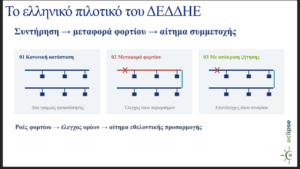
The session then focused on the Greek Virtual Pilot and its N−1 use case, which investigates how temporary and voluntary demand adaptation by end users can support network operation following a load transfer between medium-voltage (MV) feeders.
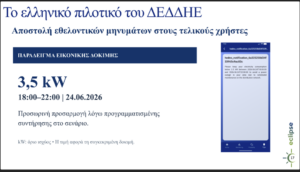
This use case explores how digital tools can connect network needs with consumer action, providing end users with personalised information that can help them adjust their consumption when flexibility is needed.
From network analysis to consumer notification
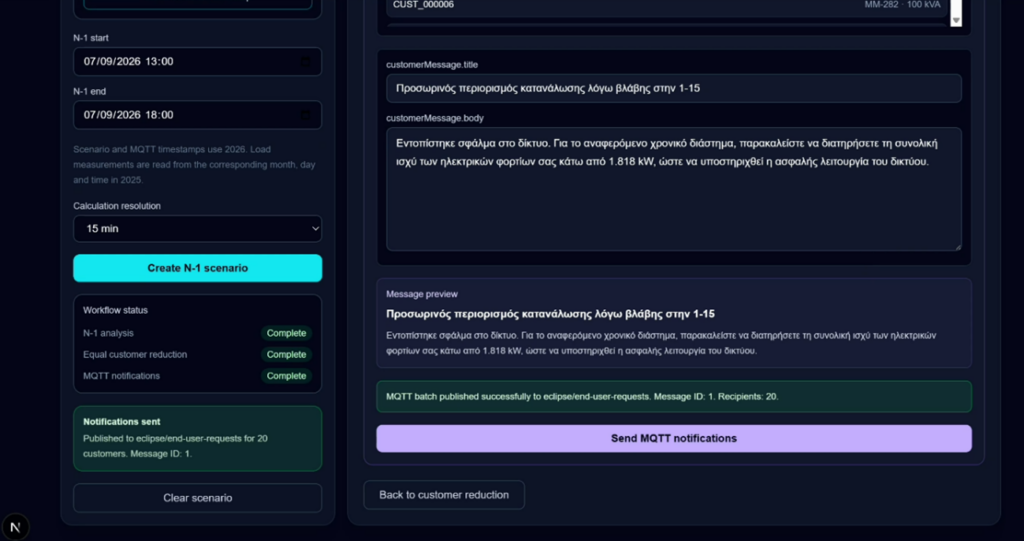
One of the highlights of the workshop was a live demonstration of the HEDNO simulation platform, showing the complete process implemented within the Greek Virtual Pilot.
Participants were taken through the different steps, from defining an N−1 network scenario and analysing the network, to calculating the required consumption adjustment and generating personalised notifications for end users.
The demonstration illustrated how information can flow from the DSO’s network analysis to the consumer, turning a specific network need into a voluntary demand response request.
Demonstrating the ECLIPSE User App
The ECLIPSE User App was also presented and demonstrated during the workshop, showing participants how the notifications generated by the virtual pilot are received and displayed to end users.
This provided a practical illustration of the end-to-end approach being explored by ECLIPSE:
from identifying a network need and determining the required flexibility, to communicating a personalised request to consumers through a digital application.
At the end of the session, participants were invited to register to access the ECLIPSE User App and take part as friendly users in the pilot testing activities.
Strengthening the Greek pilot through internal engagement
Beyond presenting the project’s technical developments, the workshop provided an opportunity to prepare HEDNO personnel for their involvement in the upcoming pilot activities and to build a shared understanding of the technologies and concepts being developed within ECLIPSE.
Participants gained insights into CERF, interoperability challenges, ECLIPSE DIGITAL use cases and voluntary demand response, while the live demonstrations helped connect these concepts with their practical implementation in the Greek Virtual Pilot.
By bringing together project knowledge, technical demonstrations and hands-on user engagement, HEDNO continues to advance the implementation of the Greek Virtual Pilot and contribute to ECLIPSE’s objective of exploring how digitalisation can enable more flexible, interoperable and consumer-oriented energy systems.