
The ECLIPSE project demonstrates the Common European Reference Framework (CERF) across 17 EU countries, in highly diverse regulatory, market and social contexts. Demonstrating that the CERF works is one thing; understanding what it takes to replicate it elsewhere is another.
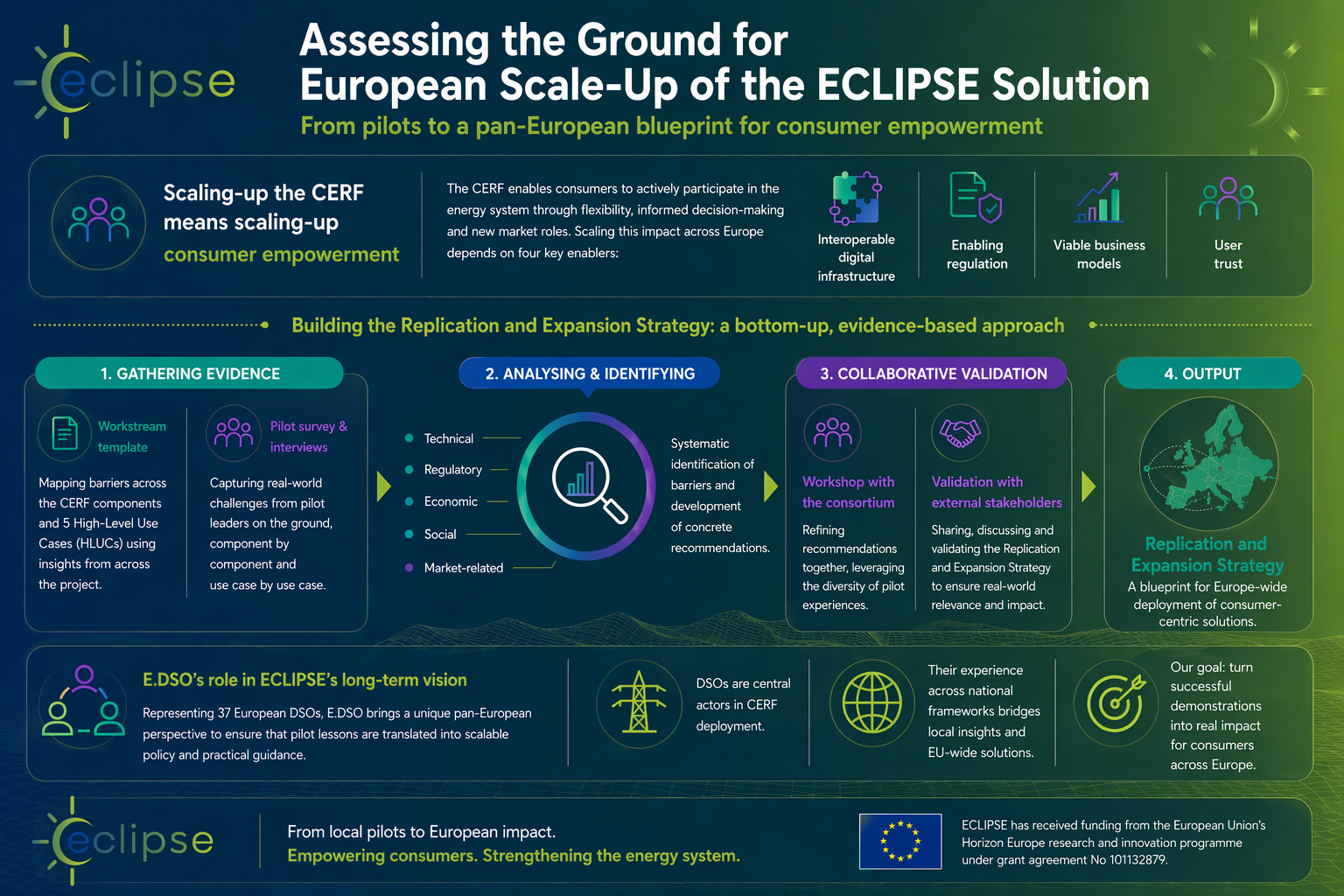
Within the ECLIPSE project, E.DSO is leading the development of the Replication and Expansion Strategy for the ECLIPSE Solution. This task sits at the end of the project timeline but its importance extends well beyond its duration: it is what transforms a successful demonstration into a blueprint for Europe-wide deployment. In close cooperation with the project’s pilots, the E.DSO team has started systematically identifying the barriers – technical, regulatory, economic, social or market-related – that could hinder scale-up and propose concrete recommendations to overcome them.
Scaling-up the CERF means scaling-up consumer empowerment
At its core, this work is about consumer empowerment. The CERF is designed to enable consumers to actively participate in the energy system, through flexibility, informed decision-making and new market roles. However, empowerment does not scale automatically. It depends on interoperable digital infrastructure, enabling regulation, viable business models and, crucially, user trust. Identifying where these conditions are not yet met, and how to address those gaps, is essential if the benefits demonstrated in ECLIPSE are to reach consumers across Europe.
So far, two structured instruments to gather bottom-up evidence from across the pilots in a consistent and comparable way have been developed.
- The first is a template to extract information from other relevant workstreams of the project beyond the pilots. It covers the core technical components of the CERF – Customer, Aggregation, Market and Governance Domain, Data Sources and Data Repository and Exchange – as well as each of the five High-Level Use Cases (HLUCs) of the ECLIPSE consumer energy saving application. For each component, partners are asked to characterise the barrier type, describe it with reference to project deliverables and propose recommendations.
- The second instrument is a pilot survey, designed to capture the practical challenges encountered by teams actually deploying the CERF on the ground. Pilot leaders will fill in the survey component by component, indicating which HLUCs are affected by each barrier and how, and offering their own recommendations for future deployments. In-depth interviews with pilot leaders will further complement this evidence base.
A Collaborative Process: Workshops on Recommendations and Validation with Pilots and External Stakeholders
Following analysis of the collected inputs, two dedicated workshops will be organised. The first one will focus on the recommendations to overcome the identified barriers to scaling up the ECLIPSE solution and will bring together the entire consortium. The second one will involve external stakeholders working closely with the ECLIPSE project in order to share, discuss and reflect with them on the Replication and Expansion Strategy which they will validate before it is finalised.
E.DSO’s Role in ECLIPSE’s Long-Term Vision
As the association representing 37 European DSOs, E.DSO will leverage its pan-European perspective that is well-suited to a task focused on cross-border replicability. DSOs are central actors in CERF deployment, and their experience across different national frameworks makes them a natural bridge between pilot lessons and scalable policy guidance. Ultimately, the value of ECLIPSE will not be measured by the success of its demonstrations alone, but by its ability to inform replication at scale. By systematically identifying barriers and translating them into concrete recommendations, E.DSO’s work helps ensure that consumer-centric solutions are scaled-up across Europe, supporting a more flexible, participatory and resilient energy system.